Skip to content

Load Testing Blog

Java Arrays

You're probably not the first one to wonder how arrays work in Java. And you haven't found a clear answer yet! I have some good news... This post is all about understand how arrays work, how to create them, how to store data and much more. I promise, you won't be disappointed!

Let's dive into the world of those mysterious arrays!

What is an Array

Java Array

Java Arrays are part of primitive types. It means an array is part of the language syntax, not a class.

An Array data structure consists of a collection of elements stored sequentially and accessible through an index (usually an integer).

Java ArrayList

I guess you're here because you want to learn how to use the ArrayList in your Java code. You're in the right place!

As explained in the Java documentation, ArrayList is:

  • A resizable array: implementing the List interface,
  • Mutable: objects can be added and/or removed,
  • Not Thread-safe: ArrayList is not suitable for concurrent access. See Thread Safety for more information.

Let's explore how to use an ArrayList through simple code examples!

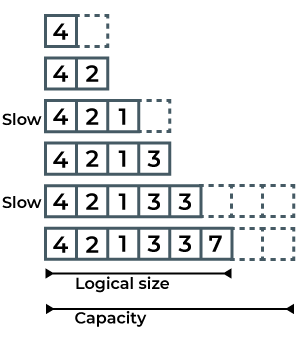
How Array List Works

Dynamic Array

Java LinkedList

The question which often arises is: are LinkedList preferable to ArrayList? In which case should I use it?

As explained in the Java documentation, LinkedList is:

  • A doubly-linked chain: elements are stored in nodes, with linking back and forth between themselves,
  • Mutable: objects can be added and/or removed,
  • Not Thread-safe: LinkedList is not suitable for concurrent access. See Thread Safety for more information.

Let's explore how to use a LinkedList through simple code examples! And find out when a LinkedList instead of an ArrayList should be used.

Java Math.pow Through Code Examples

I'm sure you have already experienced odd results when calling Math.pow method. I know, I've been there too!

Math.pow(double a, double b) returns the value of a raised to the power of b.

It's a static method on Math class, which means you don't have to instantiate a Math instance to call it. The power of a number is the number of times the number is multiplied by itself.

Securing a Rest API with Spring Security

Most Spring Tutorials available online teach you how to secure a Rest API with Spring with examples which are far from real application problematics. You surely agree that most tutorials lack real-world use-cases.

This tutorial aims to help you secure a real-world application, not just another Hello World Example.

In this tutorial we'll learn:

  • How to secure a Spring MVC Rest API using Spring Security,
  • Configure Spring Security with Java code (no painful XML),
  • And delegate authentication to a UserAuthenticationService with your own business logic.

I've spent several weeks tweaking Spring Security to come up with this simple setup. Let's go!

Complete Source code is available on Github.