
OctoPerf vs BlazeMeter: Which JMeter-based Performance Testing Platform Should You Choose in 2026?
When evaluating Apache JMeter based enterprise-grade performance testing platforms, two names frequently appear on the shortlist: OctoPerf and BlazeMeter.
Both platforms help engineering teams execute large-scale load tests, validate application scalability and integrate performance testing into modern CI/CD pipelines. Both support Apache JMeter and both provide cloud-based infrastructure capable of generating traffic from multiple geographic regions.
At first glance, they seem very similar. In reality, they take very different approaches to performance engineering.
BlazeMeter has evolved into a broader continuous testing platform covering multiple testing disciplines. OctoPerf has remained focused on one mission: making performance testing accessible, scalable and efficient for organizations of all sizes.
As a result, the most significant differences between the two platforms are not necessarily found in their ability to execute load tests, but rather in areas such as licensing flexibility, analytics depth, deployment options and the growing role of AI in performance engineering workflows.
Table of Contents
- OctoPerf vs BlazeMeter at a Glance
- JMeter Compatibility, Reversibility and Migration
- Supporting JMeter Experts and Non-Experts
- Security and Deployment Flexibility
- Pricing: The Difference Is Bigger Than It Looks
- Reporting and Analysis
- Beyond Load Testing: Where BlazeMeter Has the Advantage
- AI, MCP and the Future of Performance Engineering
- Final Verdict
OctoPerf vs BlazeMeter at a Glance
Before diving into the details, here is a high-level comparison of the two platforms.
| Criteria | OctoPerf | BlazeMeter |
|---|---|---|
| Apache JMeter Support | ✅ Native | ✅ Native |
| JMX Import | ✅ Yes | ✅ Yes |
| JMX Export | ✅ Anytime | Limited emphasis |
| Vendor Lock-In | None | Medium |
| Migration Tool from one tool to another | ✅ | N/A |
| JTL Result Import | ✅ | N/A |
| Visual Script Creation | ✅ Scripting Studio | ✅ |
| AI-Assisted Script Generation | ✅ Advanced Hosted MCP Server | ✅ Basic MCP Capabilities |
| Free Tier | Unlimited tests | Limited monthly tests |
| Pricing Model | Virtual User Capacity (Unlimited Usage) | Virtual User Capacity + Usage Restrictions |
| Unlimited Test Executions | ✅ | ❌ |
| Unlimited Concurrent Runs | ✅ | Plan-dependent |
| License Sharing Across Teams | ✅ | More restrictive |
| Cloud Regions | 78+ | ~51 |
| Private Load Generators | ✅ | ✅ |
| Hybrid Deployment | ✅ | ✅ |
| Fully Secured On-Premises Platform | ✅ | ❌ |
| Reporting Customization | Fully Dynamic & Customizable | Standardized Dashboards |
| Service Virtualization | ❌ | ✅ |
| Test Data Management | ❌ | ✅ |
| Test-as-Code Roadmap | ✅ Expected Q3 2026 | ✅ |
The table already hints at the pattern, OctoPerf optimizes for openness and depth on performance engineering, while BlazeMeter spreads across a wider testing suite. The sections below unpack what that means in practice.
JMeter Compatibility, Reversibility and Migration

Apache JMeter remains the most widely adopted open-source load testing framework in the industry. Most organizations evaluating a performance testing platform already own years of investment in JMX files, custom plugins, test plans and automation pipelines. This makes compatibility a critical factor, and it is a recurring theme in our JMeter vs OctoPerf comparison.
Both BlazeMeter and OctoPerf support JMeter. The difference lies in how much freedom users retain over their assets.
OctoPerf was built around the idea that customers should never lose ownership of their testing assets. Everything created in OctoPerf can be exported back to JMeter at any time, which is also why we chose JMeter as the engine in the first place. This significantly reduces vendor lock-in, since organizations remain free to move their scripts elsewhere without having to rebuild their testing assets from scratch.
For teams already using BlazeMeter, OctoPerf also provides migration tooling designed specifically to accelerate platform transitions. Full migration capabilities include:
- JMX import and export,
- BlazeMeter migration plugin,
- JTL result import and export.
Supporting JMeter Experts and Non-Experts

One of the most interesting aspects of OctoPerf's approach is that it recognizes not every user is a JMeter expert. Historically, creating performance tests required understanding thread groups, controllers, samplers, listeners and many other JMeter concepts.
Experienced performance engineers can continue working directly with JMeter assets and maintain full control over their scripts. At the same time, less experienced users can leverage OctoPerf's codeless drag-and-drop Scripting Studio to create scenarios without needing deep JMeter expertise.
More recently, the OctoPerf MCP Server has introduced AI-assisted workflows. Users can describe a user journey, an API workflow or a performance testing objective using natural language and let AI generate the initial test structure.
This creates a unique dual-path experience:
- Experts keep full access to JMeter,
- Newcomers become productive much faster through the no-code scripting studio and AI assistance.
Security and Deployment Flexibility
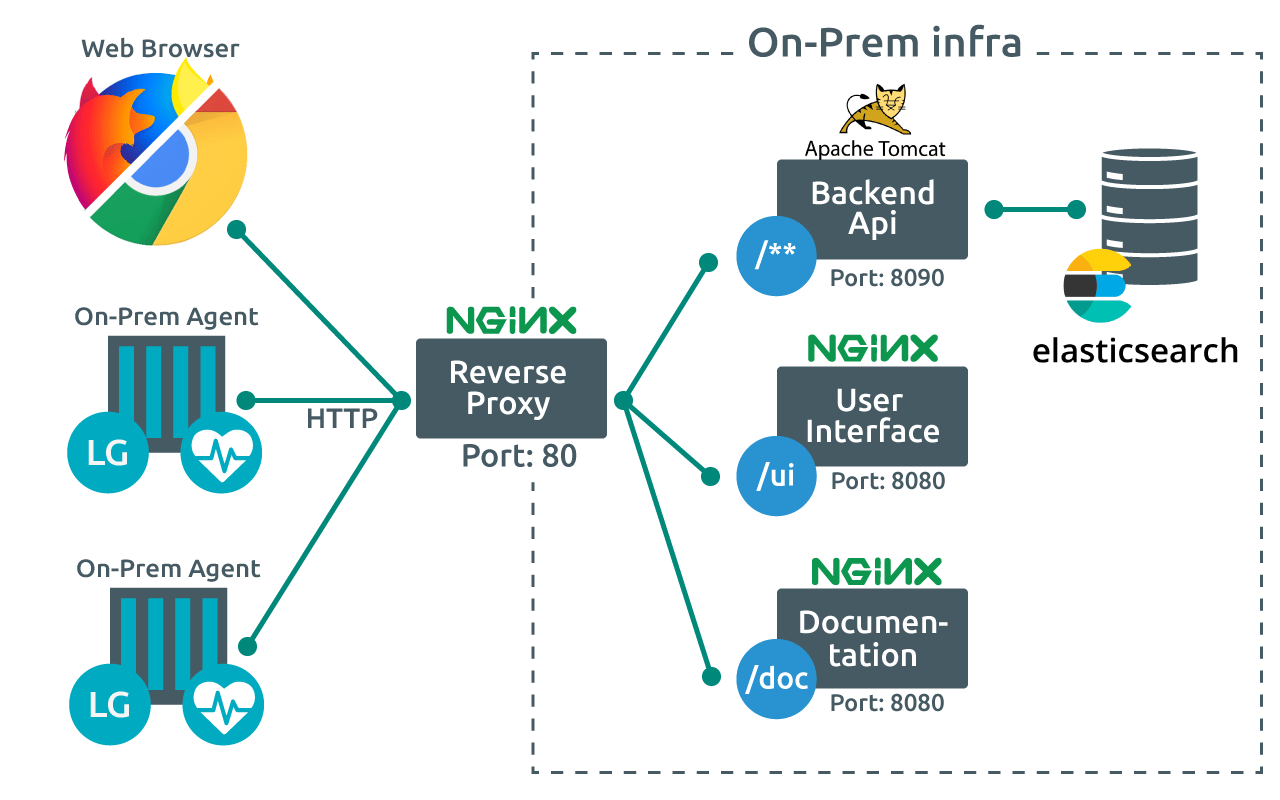
Security requirements are becoming one of the most important decision criteria during software procurement. Both BlazeMeter and OctoPerf support private load generators deployed inside customer networks and connected to a SaaS platform.
However, OctoPerf additionally supports:
- Fully managed SaaS,
- Hybrid SaaS with private load generators,
- Fully on-premises deployment.
The fully on-premises option allows organizations to deploy the entire platform locally, disconnected from the internet if necessary. Scripts, reports, execution data and platform services remain entirely under customer control. For organizations operating under strict compliance requirements, this capability can be decisive, as we detail in our cloud vs on-premises breakdown and our on-premise provider guide.
Pricing: The Difference Is Bigger Than It Looks

At first glance, both BlazeMeter and OctoPerf follow a relatively similar pricing philosophy: customers purchase a license associated with a maximum virtual user (VU) capacity. The difference appears when looking beyond that virtual user limit.
Compared to BlazeMeter, OctoPerf offers:
- Lower licensing costs,
- Unlimited test executions,
- Unlimited test duration,
- Unlimited concurrent test campaigns,
- Organization-wide license sharing,
- Access to all platform features without upselling.
OctoPerf's licensing model is significantly more flexible because the virtual user capacity is essentially the only limitation. By contrast, BlazeMeter plans tend to introduce additional constraints around platform usage, particularly regarding execution restrictions.
Organizations frequently observe BlazeMeter licensing costs ranging from two to three times higher than equivalent OctoPerf configurations. As a result, OctoPerf often delivers a substantially lower total cost of ownership while encouraging teams to run more tests rather than optimizing around platform consumption. This is exactly the trade-off we explore on our dedicated BlazeMeter alternative page.
Reporting and Analysis
Both BlazeMeter and OctoPerf address one of the historical limitations of Apache JMeter: while JMeter excels at executing tests, its native reporting capabilities remain limited. Teams often need to manually aggregate results, build their own dashboards and correlate metrics from multiple sources before meaningful analysis can begin, a pain point we cover in depth in how to analyze JMeter results.
Both platforms provide real-time visibility into running tests and automate much of this analysis process. However, when comparing OctoPerf vs BlazeMeter reporting capabilities, OctoPerf provides a significantly deeper analytics experience thanks to its dynamic reporting engine.
Unlike traditional static dashboards, OctoPerf's reporting engine is entirely dynamic. Users can:
- Filter data by request,
- Filter by transaction,
- Filter by user profile,
- Filter by injection location,
- Customize metrics,
- Compare results,
- Drill down into specific requests,
- Build stakeholder-specific dashboards.
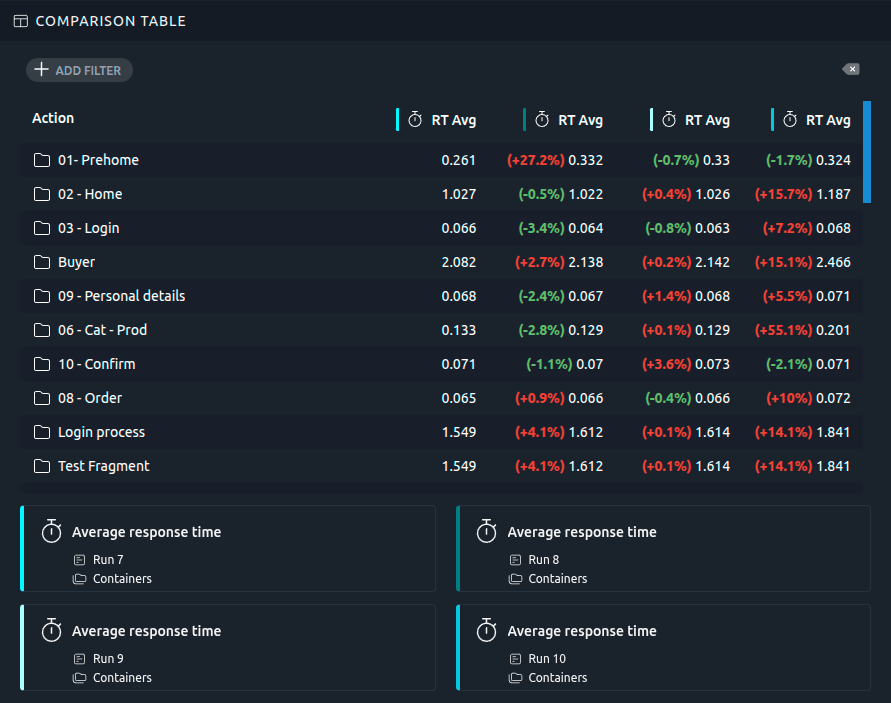
OctoPerf also provides reusable report templates that can automatically be applied to future campaigns. In addition, teams can compare reports over time to quickly identify regressions, improvements and behavioral changes between releases. For organizations that rely heavily on performance analysis, these capabilities make a significant difference.
Beyond Load Testing: Where BlazeMeter Has the Advantage
To provide a balanced comparison, it is important to acknowledge where BlazeMeter remains ahead. BlazeMeter's broader platform includes capabilities beyond performance testing, such as:
- Service Virtualization,
- API Testing,
- Test Data Management,
- Multi-framework support through Taurus.
Organizations seeking a unified testing suite may find these capabilities attractive, especially when performance testing is only one part of a much wider quality strategy.
AI, MCP and the Future of Performance Engineering

Both BlazeMeter and OctoPerf have invested heavily in AI-driven capabilities during the past year. Both vendors are exploring MCP (Model Context Protocol) integrations that enable AI assistants to interact with performance testing workflows. However, the maturity and scope of the implementations differ significantly.
OctoPerf provides a fully hosted MCP Server capable of connecting to OpenAI, Gemini, Claude, Mistral and other compatible models. Unlike most performance testing platforms, OctoPerf enables users to orchestrate an entire performance testing lifecycle directly from a Large Language Model (LLM). Users can:
- Create scripts,
- Configure correlations,
- Design workloads,
- Launch tests,
- Monitor executions,
- Analyze results,
- Receive optimization recommendations.
All through natural language interactions. This capability is enabled by OctoPerf's extensive API coverage, allowing the AI assistant to act as a true platform orchestrator rather than a simple helper. The result is faster onboarding, faster test creation, improved productivity and more relevant recommendations.
Final Verdict
BlazeMeter remains a strong option for organizations looking for a broader continuous testing suite that combines performance testing, service virtualization, API testing and test data management.
However, for organizations primarily focused on performance engineering, OctoPerf presents a compelling alternative. It combines:
- Deep Apache JMeter compatibility,
- Minimal vendor lock-in,
- Easier migration paths,
- Strong deployment flexibility,
- Full on-premises support,
- Predictable and cost-effective licensing,
- Unlimited test executions and concurrency,
- Industry-leading reporting and analytics,
- AI-powered end-to-end performance testing workflows.
Most importantly, it enables both performance testing specialists and complete newcomers to succeed on the same platform.
As performance testing becomes a shared responsibility across engineering organizations, the combination of flexibility, analytics depth, deployment options and AI-driven automation makes OctoPerf one of the most compelling performance engineering platforms available today. If you want to dig further, our roundup of the best load testing tools in 2026 puts both platforms in a wider context.