Migrating Your BlazeMeter Tests With an AI Agent
Our BlazeMeter to OctoPerf Maven plugin is archived. What replaces it is not another tool to install: OctoPerf 17 ships a BlazeMeter migration playbook for AI agents.
Real prompts, real output, run against a real BlazeMeter account.
Table of Contents
- Why the Plugin Is Archived
- Your Keys Stay Yours
- Step 1: Inventory First
- Step 2: The Import
- Step 3: The CSV Trap
- Step 4: The Load Profile
- Step 5: Validate
- What Does Not Come Across
- Conclusion
Why the Plugin Is Archived

The plugin worked: one mvn command copied your workspaces, projects and JMeter scripts into OctoPerf. But a Maven command cannot ask you a question, so it never said which tests were worth moving, never brought your load profiles, and never replayed what it imported. Those three gaps are the migration. Fetching a .jmx over HTTP is the easy part.
So we wrote no importer, and you need none. A BlazeMeter test is an Apache JMeter .jmx, its data files and a load profile, three things OctoPerf already reads. What was missing was the decisions in between, and that is what the playbook in the OctoPerf MCP server makes.
Your Keys Stay Yours
BlazeMeter authenticates with an API key id and secret. You give them to your own agent, and your agent calls BlazeMeter, not OctoPerf. Our servers never touch a.blazemeter.com: what arrives here is bytes, a .jmx, a .csv, a scenario. No third party holds your credentials, and the export is you exporting your own data.
Check that your agreement with BlazeMeter/Perforce allows it before you start. OctoPerf is not affiliated with BlazeMeter, and BlazeMeter is a trademark of Perforce Software.
Step 1: Inventory First
Your first prompt is not an import.
Here are my BlazeMeter API keys. Before migrating anything, tell me what this account holds and what is worth moving.
Nothing gets created. On our own account:
workspace  "Default workspace"  (1)
projects   Default project, Gatling, wdsfga, JMX  (4)
tests      8 performance, 0 functional, 0 multi-tests

scriptType histogram
  1  jmeter
  1  taurus
  3  gatling
  3  (unset)
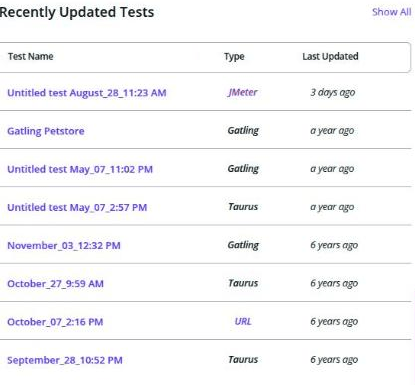
Each test's scriptType gives you its verdict:
scriptType |
Verdict | Why |
|---|---|---|
jmeter |
Mechanical | The .jmx is what OctoPerf already reads |
taurus |
Assisted | Mechanical when the YAML points at a .jmx, hand-built when the requests are inline |
selenium |
Manual | A Java, Python or C# project, so a rewrite rather than a conversion |
| gatling, locust, grinder, pytest, robot | Not migrated | No OctoPerf equivalent, the traffic has to be rebuilt |
One test out of eight converts mechanically here. Three are Gatling Scala simulations nothing will translate, and three have no script and no files at all: created once, abandoned, still in the list.
If your account is nine tenths Gatling, you are not facing a difficult migration, you are facing a different project. Five minutes is a good moment to find out.
Step 2: The Import
Migrate the JMeter test. Mirror the BlazeMeter hierarchy on the OctoPerf side.
One workspace per workspace, one design project per project.
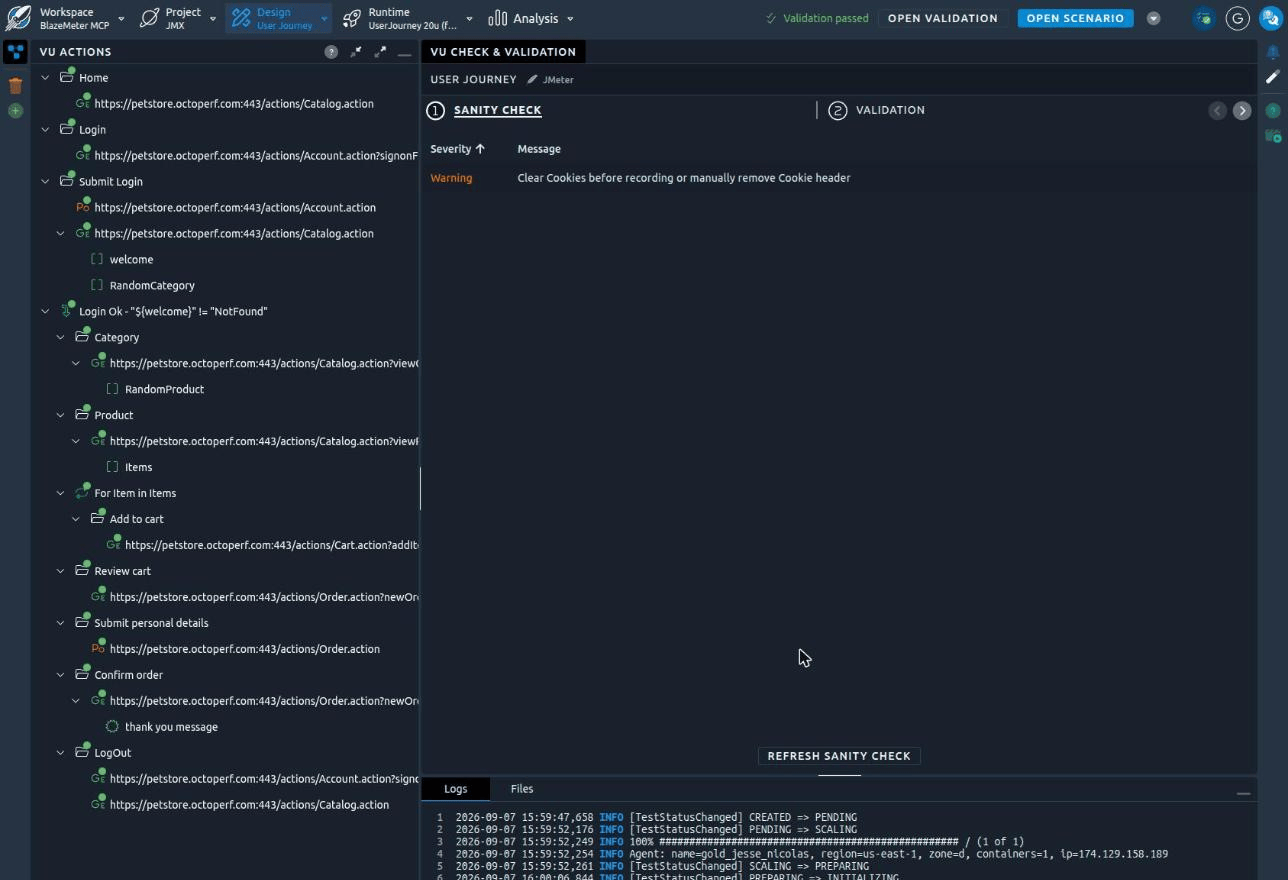
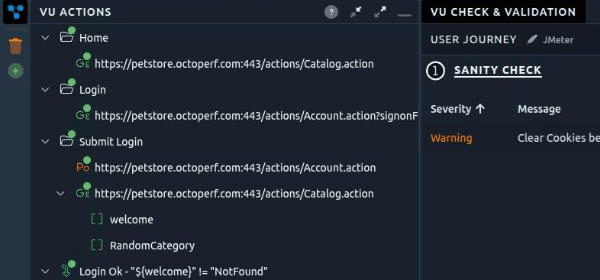
Our UserJourney.jmx crossed over whole: ten Transaction Controllers became named containers, four regex extractors kept their names, the IfController kept its condition in the node name (Login Ok - "${welcome}" != "NotFound"), the ForeachController became For Item in Items.
Your Taurus tests split in two: a YAML whose script: names a .jmx takes the same path, while inline requests: get rebuilt, exactly for a flat list of URLs and approximately once there are bodies or extractors.
Step 3: The CSV Trap
This is where a BlazeMeter migration quietly breaks.
The BlazeMeter Test Data Model describes our credentials.csv with the columns user1 and pass. The CSVDataSet inside the same test's .jmx disagrees:
<stringProp name="variableNames">login,password</stringProp>
<boolProp name="ignoreFirstLine">false</boolProp>
Only the script's names are substituted at runtime. Its requests read ${login} and ${password}; ${user1} appears nowhere. Build your variable from the data model and you get two columns nothing uses, plus a login step sending an empty user.
You do not have to build anything: the JMX import already made the variable, with the right names and file. Add a second one over the same CSV and the sanity check tells you off, "File x.csv is used by multiple csv variables. This can lead to unpredictable behavior."
One last trap in that file: its first line is user1,pass, which looks like a header and is a real credential pair. Treat it as one and you drop an account.
Step 4: The Load Profile
The numbers you need are already in the test:
{ "concurrency": 20, "rampUp": "1m", "holdFor": "19m", "steps": 0,
  "locations": { "us-east4-a": 20 } }
That becomes a scenario: a plain ramp-up, or ascending stairs when steps is above 1.
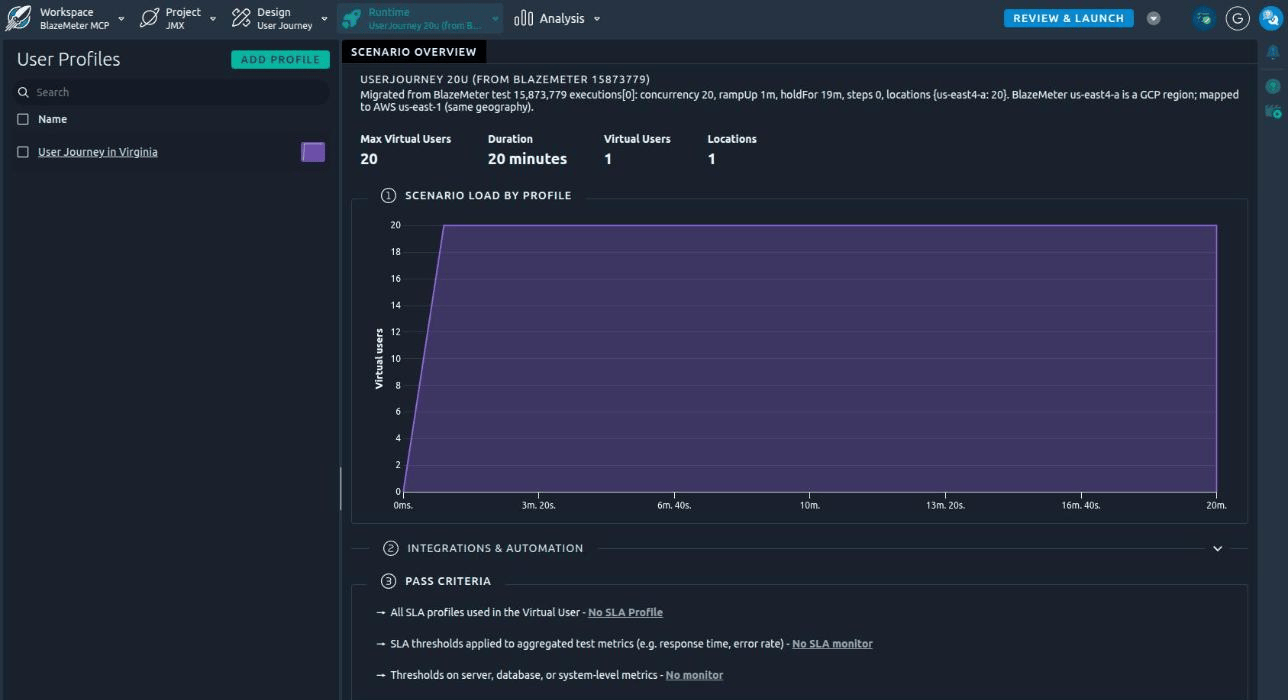
Two numbers do not carry over as they are. Your location is not even the same cloud: BlazeMeter's own UI spells us-east4-a out as US East (Virginia, Google), and our public providers are AWS, Digital Ocean and Azure, so you pick the closest equivalent rather than look one up. We took AWS us-east-1. Your concurrency is split across locations by BlazeMeter, while OctoPerf applies users to each user profile: one Virtual User means 20 stays 20, but spread that test over three locations and you divide.
Failure criteria do not convert. Ours were empty, but if your tests carry thresholds you rebuild them as an SLA profile.
Step 5: Validate
Validate the imported Virtual User.
An import that has never run is not a migration. Validation replays the Virtual User on a real load generator and costs no test hours.
Ours passed on the first run, dynamic values resolved for real: categoryId=CATS, productId=FL-DLH-02, workingItemId=EST-16 then EST-17. The only remark was a Cookie header left over from the original recording.
Do not expect that on a bigger account: your first run will usually be red on session tokens and CSRF values, which is what validation triage and auto-correlation are for. Wait until one Virtual User is clean before launching a scenario, because a run burns test hours and a validation does not.
What Does Not Come Across
You get told this at the end of the migration, not three weeks later:
| Test | Type | Result | Notes |
|---|---|---|---|
| Untitled test August_28 | jmeter |
Migrated | 1 VU, 1 data file, scenario UserJourney 20u |
| October_07_2:16 PM | taurus |
Partial | Inline requests rebuilt as 1 GET |
| Gatling Petstore | gatling |
Not migrated | Scala simulation, needs rebuilding |
| Untitled test May_07_11:02 PM | gatling |
Not migrated | Same simulation file |
| November_03_12:32 PM | gatling |
Not migrated | Scala simulation |
| October_27, September_28, May_07_2:57 PM | none | Nothing to migrate | No script, no files |
Whatever your account holds, these never come across: functional tests, multi-tests, mock services, API monitors, private locations, thresholds, historical reports and trends, team members and permissions.
Conclusion
Five prompts: survey, import, check the data, build the scenario, validate. The playbook ships with OctoPerf 17. Mid-migration with the plugin? Nothing is lost, the Virtual Users it created are ordinary Virtual Users and the playbook picks up from there.
Run the inventory first. It writes nothing, costs nothing, and tells you the one thing about your migration that is genuinely hard to guess. Our BlazeMeter comparison and the alternative page cover the rest.
The NeoLoad and LoadRunner walkthroughs follow the same path, on projects that do need an importer.